Second Moment of Area Calculator
I_y · W_y · Cross-section Design · Parallel Axis Theorem
Cross-Section Calculator
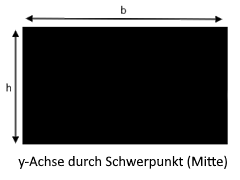
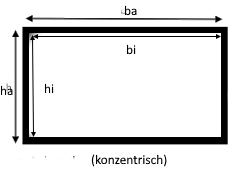
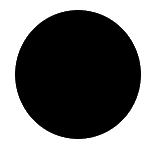
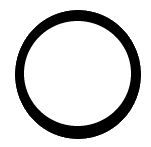
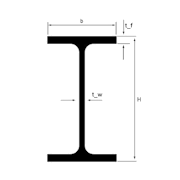
Formulas & Cross-Section Reference
I_y = b · h³ / 12 [cm⁴]
W_y = b · h² / 6 [cm³]
e = h/2 | A = b · h [cm²]
I_y = (b_o · h_o³ − b_i · h_i³) / 12 [cm⁴]
W_y = I_y / (h_o/2) [cm³]
I_y = π · d⁴ / 64 [cm⁴]
W_y = π · d³ / 32 [cm³]
e = d/2
I_y = π · (D⁴ − d⁴) / 64 [cm⁴]
W_y = I_y / (D/2) [cm³]
I_y = (b·H³ − (b−t_w)·h_w³) / 12 [cm⁴]
h_w = H − 2·t_f (web height)
W_y = I_y / (H/2) [cm³]
I_total = I_S + A · d² [cm⁴]
I_S = own second moment of area (about centroidal axis)
A = area of partial section, d = axis offset
W_y = I_y / e [cm³]
e = distance from centroid to extreme fibre [mm → cm: /10]
Units & Conversions
| I [cm⁴] | × 10⁴ → mm⁴ ÷ 10⁴ → m⁴ |
| W [cm³] | × 10³ → mm³ σ = M[kN·m]×10⁶/W[mm³] |
| A [cm²] | × 100 → mm² |
Reference – Steel Sections
| Section | I_y [cm⁴] | W_y [cm³] | A [cm²] |
|---|---|---|---|
| IPE 200 | 1,943 | 194 | 28.5 |
| IPE 270 | 5,790 | 429 | 45.9 |
| IPE 360 | 16,270 | 904 | 72.7 |
| HEB 200 | 5,696 | 570 | 78.1 |
| HEB 300 | 25,170 | 1,678 | 149.1 |
Second Moment of Area – Fundamentals & Significance
What is the Second Moment of Area?
The second moment of area I_y (also: area moment of inertia, moment of inertia of area) is the most important cross-sectional property for bending-loaded structural members. It describes how resistant a cross-section is to bending about a given axis. The larger I_y, the smaller the deflection and bending stress under the same load — which is why I-beams are so efficient: their material is placed as far as possible from the neutral axis.
I_y grows with h³ – not linearly!
For rectangle I = b·h³/12:
| Width b | Height h | I_y [cm⁴] |
|---|---|---|
| 10 cm | 10 cm | 833 |
| 10 cm | 20 cm | 6,667 |
| 10 cm | 30 cm | 22,500 |
| 20 cm | 10 cm | 1,667 |
Section Modulus W_y
W_y = I_y / e → σ_b = M / W_y
| Section | W_y [cm³] | Effect |
|---|---|---|
| b/h = 10/10 | 167 | Base |
| b/h = 10/20 | 667 | 4× |
| b/h = 10/30 | 1,500 | 9× |
| IPE 270 | 429 | efficient |
Formula Derivation and Significance
1. Definition – Second Moment of Area
I_y = ∫ z² · dA [cm⁴]
z = distance of area element dA from bending axis y. For a rectangle: integrating strips b·dz from –h/2 to +h/2 gives b·h³/12.
2. Parallel Axis Theorem (Steiner's Theorem)
I_S = own second moment of area (about centroidal axis)
A = area of partial section, d = distance between centroidal axis and new axis
Applications: T-sections, composite sections, asymmetric profiles
Important: The Steiner term A·d² can be much larger than I_S — material far from the axis is very effective!
3. Polar Second Moment of Area (Torsion)
Valid for circular cross-sections; for open sections (I, U, T) the torsional constant I_T must be determined separately.
Practical Example: T-Section from Two Rectangles
Problem:
T-section: flange 20 × 3 cm, web 3 × 17 cm. Total height H = 20 cm. Determine centroid, then calculate I_y.
Solution:
- A₁ (flange) = 20 × 3 = 60 cm², z₁ = 20 − 1.5 = 18.5 cm (from bottom)
- A₂ (web) = 3 × 17 = 51 cm², z₂ = 17/2 = 8.5 cm (from bottom)
- Centroid: ȳ = (60 × 18.5 + 51 × 8.5) / (60+51) = 14.0 cm from bottom
- I_S1 = 20×3³/12 = 45 cm⁴ | d₁ = 18.5−14.0 = 4.5 cm → Steiner: 60×4.5² = 1,215 cm⁴
- I_S2 = 3×17³/12 = 1,240 cm⁴ | d₂ = 14.0−8.5 = 5.5 cm → Steiner: 51×5.5² = 1,543 cm⁴
- I_y = 45+1,215+1,240+1,543 = 4,043 cm⁴
- W_y,top = 4,043/(20−14) = 674 cm³ | W_y,bottom = 4,043/14 = 289 cm³
Frequently Asked Questions
Summary
Second Moment of Area
I_y = b·h³/12 | π·d⁴/64
Unit: cm⁴ | mm⁴
Section Modulus
W_y = I_y / e
σ = M / W_y [N/mm²]
Parallel Axis Theorem
I_total = I_S + A·d²
For composite sections
Typical Applications
- Beam design: Sizing steel beams, timber joists, concrete slabs
- Section comparison: Which I-section is sufficient for a given bending moment?
- Composite sections: Steel-concrete composite, timber-steel hybrid (with Steiner)
- Mechanical engineering: Shafts (polar), test frames, guide rails
- Hollow sections: Crane booms, frames, columns
|
|
|
|