Resistors in Parallel
Understand parallel circuits and how to calculate total resistance
Overview
In a parallel circuit, the current divides and flows through multiple resistors simultaneously. The key characteristic of parallel circuits is that all resistors experience the same voltage.
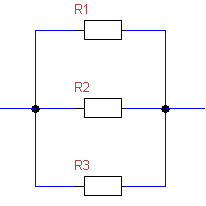
The total current divides among the branches, but the voltage across each resistor remains constant. This is the opposite of series circuits where voltage divides but current remains constant.
Total Resistance Calculation
Method 1: Using Ohm's Law
If the total current and voltage are known, we can calculate the total resistance directly using Ohm's Law:
Method 2: Using Conductivity Addition
When voltage and current values are unknown, we can add the individual conductivities (reciprocals of resistances). This is the most useful method for parallel circuits with known resistor values.
In parallel circuits, conductivities add together. Since conductivity is the reciprocal of resistance, the reciprocals of the resistances add up.
Which can also be written as:
Key observation
The total resistance in a parallel circuit is always smaller than the smallest individual resistance. This makes sense because adding parallel paths reduces overall resistance.
Worked Example: Three Resistors
Calculate Total Resistance of Three Parallel Resistors
Given:
- \(R_1 = 220\,\Omega\)
- \(R_2 = 330\,\Omega\)
- \(R_3 = 470\,\Omega\)
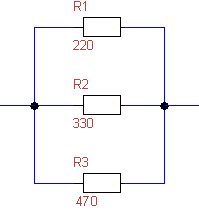
Step 1: Add the reciprocals
Step 2: Calculate the sum
Step 3: Invert to get total resistance
Result: The total resistance is \(103\,\Omega\), which is indeed smaller than the smallest resistor (220Ω).
Special Case: Two Resistors in Parallel
For the common case of only two resistors in parallel, we can simplify the formula by combining fractions:
By taking the reciprocal of both sides, we get a simpler formula:
Two Resistors in Parallel Formula
This formula is often called the "product over sum" formula.
Example: Two Resistors
Calculate Total Resistance of Two Parallel Resistors
Given:
- \(R_1 = 220\,\Omega\)
- \(R_2 = 330\,\Omega\)
Using the two-resistor formula:
Result: The total resistance is \(132\,\Omega\).
Formula Summary
General Formula (Any n Resistors)
\(\displaystyle \frac{1}{R_{\text{total}}} = \sum \frac{1}{R_i}\)Two Resistors Only
\(\displaystyle R_{\text{total}} = \frac{R_1 \cdot R_2}{R_1 + R_2}\)Using Ohm's Law
\(\displaystyle R_{\text{total}} = \frac{U}{I}\)(if U and I are known)
Key Properties of Parallel Circuits
- Same voltage across all resistors
- Total current divides among resistors
- Total resistance is smaller than any individual resistor
- Conductivities (not resistances) add together
- Adding more resistors in parallel reduces total resistance
- Removing a resistor increases total resistance
- If one branch fails (opens), others continue to work
Quick Calculation
Use the parallel resistor calculator to quickly determine total resistance for any combination of resistors:
Resistors in Parallel Calculator →
|
|
|
|