Angle Definition
Understand angles, their types, and relationships between angles
What is an Angle?
An angle is a geometric figure formed by two rays (half-lines) that share a common endpoint. The common endpoint is called the vertex of the angle.
- Vertex: The common endpoint of the two rays
- Rays: The two half-lines forming the angle
- Measure: Expressed in degrees (°), from 0° to 360°
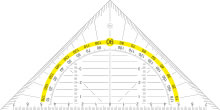
A protractor is used to measure angles in degrees. The degree symbol (°) indicates the measurement unit. A full rotation equals 360°.
Protractor Example
Types of Angles
Angles are classified based on their measure. Different angle types have different characteristics and properties.
Acute Angle
0° < angle < 90°
An acute angle is smaller than a right angle and appears sharp or pointed.
Right Angle
Angle = 90°
A right angle is formed by two perpendicular lines, often marked with a small square.
Obtuse Angle
90° < angle < 180°
An obtuse angle is larger than a right angle but smaller than a straight angle.
Straight Angle
Angle = 180°
A straight angle forms a straight line, with the two rays pointing in opposite directions.
Reflex Angle
180° < angle < 360°
A reflex angle is greater than a straight angle and is measured on the "outside" of two rays.
Complete Angle
Angle = 360°
A complete angle represents a full rotation around the vertex.
Angular Relationships
Certain pairs of angles have special relationships with each other. Understanding these relationships is useful for determining unknown angle measurements.
Complementary Angles
Definition
Two angles are complementary if the sum of their measures equals 90°.
Formula: \(\alpha + \beta = 90°\)
Example: Complementary Angles
If one angle measures 35°, its complementary angle measures 90° - 35° = 55°.
Supplementary Angles
Definition
Two angles are supplementary if the sum of their measures equals 180°.
Formula: \(\alpha + \beta = 180°\)
Example: Supplementary Angles
If one angle measures 120°, its supplementary angle measures 180° - 120° = 60°.
Adjacent Angles
Definition
Two angles are adjacent if they:
- Share a common vertex
- Share a common side
- Do not overlap (have no interior points in common)
Example: Adjacent Angles
Two angles sitting next to each other on a straight line, sharing a common side, are adjacent angles. If they are on a straight line, they are also supplementary (sum = 180°).
Vertical Angles
Definition
Two angles are vertical angles (or vertically opposite angles) if they are opposite each other when two lines intersect.
Property: Vertical angles are always equal: \(\alpha = \gamma\) and \(\beta = \delta\)
Key Points
- An angle is formed by two rays sharing a common vertex
- Angles are measured in degrees (°), with a full rotation = 360°
- Acute angles: 0° < angle < 90°
- Right angle: angle = 90°
- Obtuse angles: 90° < angle < 180°
- Straight angle: angle = 180°
- Complementary angles sum to 90°
- Supplementary angles sum to 180°
- Adjacent angles share a vertex and a side
- Vertical angles are equal when lines intersect
|
|
|
|