Matrix Reflection and Shear
Use matrices to perform geometric transformations of vectors in 2D and 3D
Geometric Transformations with Matrices
Many geometric operations (reflection, shear, rotation, scaling) can be achieved by multiplying a position vector by a suitable matrix. In this tutorial we focus on reflection and shear.
A transformation maps an input vector \(\mathbf{v}\) to an output vector \(\mathbf{v}'\) using \(\mathbf{v}' = A\mathbf{v}\).
Matrices Calculation
Matrices Addition
Matrices Subtraction
Matrices Multiplication
Matrices Inverse Cramer method
Matrices Inverse Gauss-Jordan
Matrices and Simultaneous Equations
Matrices and Determinants
Row Operations of Matrices
Matrices and Geometry, Reflection
Matrices and Geometry, Plane Rotation
Matrix Reflection (2D)
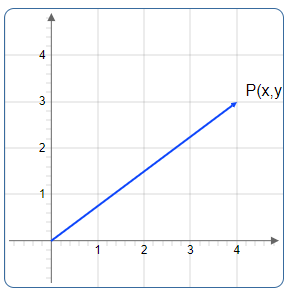
Consider a point \(P\) with coordinates \((x, y)\) in a two-dimensional space. We represent it as a vector:
Reflection Across the X-Axis
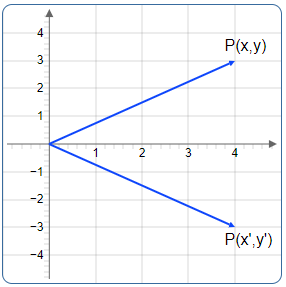
The matrix below reflects a vector across the x-axis (the y-coordinate flips sign):
Applying it to \(\mathbf{v}\) gives:
Matrix Reflection (3D)
In three dimensions, a reflection that flips the \(y\)-coordinate can be achieved by putting \(-1\) on the corresponding diagonal element of the identity matrix:
To reflect in the \(X\)-, \(Y\)- or \(Z\)-plane, place a negative sign on the corresponding diagonal element of the identity matrix.
Matrix Shear (2D)
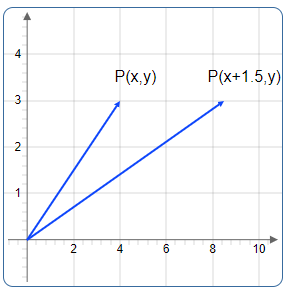
A shear transformation is produced by inserting a non-zero element outside the diagonal of the identity matrix. This shifts one coordinate proportionally to the other.
Shear Matrix Example
Apply Shear to a Vector
Input: \(\mathbf{v} = \begin{bmatrix}4 \\ 3\end{bmatrix}\)
Key Points to Remember
Reflection
Reflection flips the sign of one coordinate via a negative diagonal entryShear
Shear uses a non-zero off-diagonal element to shift one coordinate proportionallyMatrix Multiplication
Transformations are applied as \(\mathbf{v}' = A\mathbf{v}\)
|
|
|
|