Tricylinder Calculator
Calculator and formulas for calculating a tricylinder (Steinmetz solid)
Tricylinder Calculator
The Tricylinder (Steinmetz Solid)
The tricylinder is a Steinmetz solid formed by three perpendicularly intersecting cylinders.
Tricylinder Properties
The Tricylinder: Intersection of three mutually perpendicular circular cylinders
Tricylinder Visualization
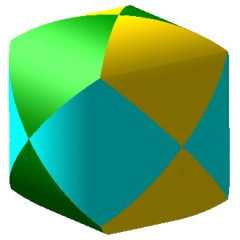
Tricylinder
Intersection of three cylinders
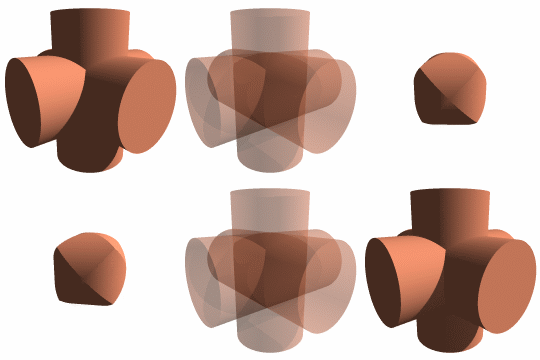


Parameters
r: Radius of all three cylinders
Three intersecting cylinders.
Steinmetz solid of the 3rd order.
What is a Tricylinder?
The tricylinder is a fascinating geometric body:
- Definition: Intersection of three circular cylinders with mutually perpendicular axes
- Steinmetz solid: Body class named after Charles Proteus Steinmetz
- Properties: Octahedral symmetry with 24 symmetry operations
- History: Archimedes and Zu Chongzhi already knew similar bodies
- Applications: Crystallography, architecture, mathematical art
- Mathematics: Complex analytical properties and integral geometry
Geometric Properties of the Tricylinder
The tricylinder shows remarkable geometric properties:
Basic Parameters
- Uniform radius r: All three cylinders have the same radius
- Orthogonal axes: The three cylinder axes are perpendicular to each other
- Cubic embedding: The tricylinder fits perfectly into a cube
- Center of symmetry: Point symmetry at the coordinate origin
Special Properties
- Octahedral symmetry: 48 symmetry operations (octahedron group)
- 24 vertices: Characteristic polyhedral structure
- Constant curvature: Same mean curvature everywhere
- Steinmetz constant: (16-8√2) as characteristic factor
Mathematical Relationships of the Tricylinder
The tricylinder follows elegant mathematical laws:
Volume Formula
The Steinmetz constant (16-8√2) ≈ 4.69 elegantly determines the volume.
Surface Area Formula
The surface area is three times the Steinmetz constant times r².
Applications of the Tricylinder
Tricylinders find applications in various fields:
Crystallography
- Octahedral crystal structures
- Mineralogical models
- Symmetry analyses
- Crystal growth
Architecture & Design
- Sculptural elements
- Modern architecture
- Structural connections
- Space-dividing elements
Science & Research
- Geometric topology
- Materials science
- Computer graphics
- 3D modeling
Art & Mathematics
- Mathematical art
- Geometric sculptures
- Educational tools
- Visualization aids
Formulas for the Tricylinder
Volume (V)
Volume with the Steinmetz constant ≈ 4.69
Surface Area (S)
Triple Steinmetz constant for the surface area
Radius from Volume
Inverse formula for radius determination
Radius from Surface Area
Alternative radius determination via surface area
Steinmetz Constant
\[K = 16 - 8\sqrt{2}\]
\[K ≈ 4.6863\]
\[\frac{V_{Tricylinder}}{V_{Cube}} = \frac{K}{8}\]
The Steinmetz constant is fundamental for all tricylinder calculations
Calculation Example for a Tricylinder
Given
Find: Volume and surface area of the tricylinder
1. Calculate Steinmetz Constant
Calculation of constant K:
\[K = 16 - 8\sqrt{2}\] \[\sqrt{2} ≈ 1.4142\] \[K = 16 - 8 \cdot 1.4142\] \[K = 16 - 11.3137 ≈ 4.6863\]The Steinmetz constant is approximately 4.6863
2. Volume Calculation
For r = 5 cm:
\[V = K \cdot r^3\] \[V = 4.6863 \cdot 5^3\] \[V = 4.6863 \cdot 125\] \[V ≈ 585.79 \text{ cm}^3\]The volume is approximately 585.79 cm³
3. Surface Area Calculation
Surface area of the tricylinder:
\[S = 3K \cdot r^2\] \[S = 3 \cdot 4.6863 \cdot 5^2\] \[S = 14.0589 \cdot 25\] \[S ≈ 351.47 \text{ cm}^2\]The surface area is approximately 351.47 cm²
4. Geometric Analysis
Ratios and properties:
Cube volume: \(V_{Cube} = (2r)^3 = 1000 \text{ cm}^3\)Ratio: \(\frac{V_{Tricylinder}}{V_{Cube}} = \frac{585.79}{1000} ≈ 0.586\)
Fill ratio: \(\frac{K}{8} ≈ 58.6\%\)
The tricylinder fills about 58.6% of the enclosing cube
5. Verification Calculations
\[r = \sqrt[3]{\frac{585.79}{4.6863}} = \sqrt[3]{125} = 5 \text{ cm} ✓\]
\[r = \sqrt{\frac{351.47}{14.0589}} = \sqrt{25} = 5 \text{ cm} ✓\]
\[\frac{V}{S} = \frac{585.79}{351.47} ≈ 1.667 = \frac{r}{3}\]
All verification calculations confirm the correct values
6. Summary
The tricylinder with all characteristic properties
7. Practical Example: Crystal Model
V ≈ 585.79 cm³
≈ 0.59 liters
S ≈ 351.47 cm²
Coating
Octahedral symmetry
Optimal space filling
A crystal model with optimal balance between volume and surface area
8. Historical Context
~250 BC
First volume calculations
~500 AD
Chinese mathematics
~1900
Naming
The tricylinder connects over 2000 years of mathematical history
The Tricylinder: Masterpiece of Intersection Geometry
The tricylinder is an extraordinary geometric body that unites the perfection of intersection geometry with the elegance of symmetry. As the intersection of three mutually perpendicular circular cylinders, it creates a body of remarkable mathematical beauty and practical significance. This unique construction, which already fascinated Archimedes and was later named after Charles Proteus Steinmetz, shows how complex three-dimensional forms can arise from simple geometric basic elements.
The Geometry of Intersection
The tricylinder shows the perfection of orthogonal intersection geometry:
- Three orthogonal cylinders: Perfect perpendicular arrangement of cylinder axes
- Steinmetz constant: (16-8√2) ≈ 4.6863 as universal factor
- Octahedral symmetry: 48 symmetry operations in highest order
- 24 characteristic vertices: Precise geometric structure
- Cubic embedding: Perfect fit into an enclosing cube
- Constant mean curvature: Uniform surface properties
- Archimedes tradition: Over 2000 years of mathematical continuity
Versatile Applications
Crystallographic Perfection
In crystallography, the tricylinder serves as a model for octahedral structures and helps understand complex crystal systems.
Architectural Innovation
Modern architecture uses the aesthetic power of the tricylinder for sculptural elements and structural connections with optimal symmetry.
Scientific Precision
In geometric topology and materials science, the tricylinder enables precise investigations of surface properties and space partitions.
Artistic Elegance
As an object of mathematical art, the tricylinder embodies the perfect balance between analytical rigor and aesthetic beauty.
Summary
The tricylinder embodies the highest form of geometric elegance and mathematical precision. Its form, created by the intersection of three orthogonal cylinders and described by the universal Steinmetz constant (16-8√2), makes it one of the most fascinating geometric bodies ever. The octahedral symmetry with 48 symmetry operations shows the highest order of three-dimensional harmony. From crystallographic models to architectural masterpieces to scientific visualizations - the tricylinder proves that the most complex mathematical constructions often produce the most beautiful and practical solutions. It is living proof that Archimedes' genius still finds new inspiration and practical applications after more than 2000 years and shows how the intersection of simple forms can lead to extraordinary complexity and beauty.