Triangle Altitude and Orthocenter
Understand altitudes, the orthocenter, and their behavior in different triangle types
Overview
An altitude (or height) of a triangle is a perpendicular line segment from a vertex to the opposite side (or the line containing that side). Altitudes are fundamental elements in triangle geometry and have important properties.
An altitude of a triangle is a line segment drawn from a vertex perpendicular to the opposite side (or the line containing the opposite side). The point where the altitude meets the opposite side is called the foot of the altitude.
- Every triangle has exactly three altitudes
- Altitudes form right angles (90°) with the opposite side
- All three altitudes intersect at a single point called the orthocenter
Angle bisector
Median
Altitude and the Orthocenter
Triangle bisector
Pythagorean theorem
Pythagorean triples
Circle
Square
Rectangle
Rhombus
Parallelogram
Trapezoid
The Orthocenter
The orthocenter is the point where all three altitudes of a triangle intersect. Its location depends on the type of triangle.
Orthocenter Properties
- The orthocenter is the intersection of all three altitudes
- Every triangle has exactly one orthocenter
- The position of the orthocenter depends on the type of triangle
- For an acute triangle, the orthocenter is inside the triangle
- For a right triangle, the orthocenter is at the vertex of the right angle
- For an obtuse triangle, the orthocenter is outside the triangle
Visual Example
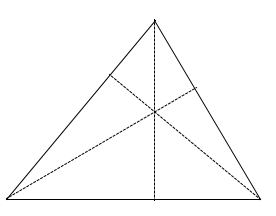
Orthocenter Position by Triangle Type
The location of the orthocenter varies significantly depending on whether the triangle is acute, right, or obtuse.
Acute Triangle
All angles < 90°
Orthocenter location: Inside the triangle
All three altitudes intersect at a point within the triangle's interior. This is the most common case.
Right Triangle
One angle = 90°
Orthocenter location: At the vertex of the right angle
The two legs of the right triangle serve as altitudes, and they intersect at the right angle vertex. This vertex is the orthocenter.
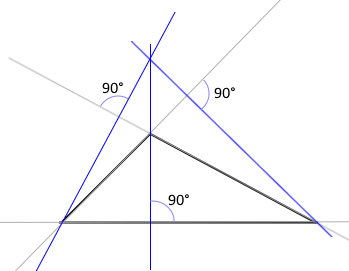
Obtuse Triangle
One angle > 90°
Orthocenter location: Outside the triangle
The altitudes from the acute angles must be extended beyond the triangle to meet at the orthocenter, which lies outside the triangle.
Altitude Properties
Altitudes have several important geometric properties that are useful in triangle analysis and calculations.
Key Characteristics
- Each altitude is perpendicular to its opposite side
- The foot of the altitude may lie on the side itself or on an extension of the side
- In an acute triangle, all feet lie on the sides themselves
- In an obtuse triangle, two feet lie on extensions of the sides
- Altitudes can be used to calculate the area of the triangle
- The three altitudes are generally different lengths (unless the triangle is equilateral)
Area Calculation Using Altitude
One of the most important uses of altitudes is to calculate the area of a triangle. The formula is simple and elegant.
For any triangle with base \(b\) and corresponding altitude (height) \(h\):
Example
If a triangle has a base of 8 cm and a corresponding altitude of 6 cm, then:
\(\displaystyle A = \frac{1}{2} \cdot 8 \cdot 6 = 24 \text{ cm}^2\)
Comparison: Altitude vs Median vs Angle Bisector
Altitude
From: Vertex perpendicular to opposite side
Angle: 90° to side
Meets at: Orthocenter
Median
From: Vertex to midpoint of opposite side
Angle: Not perpendicular
Meets at: Centroid
Angle Bisector
From: Vertex bisects the angle
Angle: Bisects vertex angle
Meets at: Incenter
Key Points
- An altitude is a perpendicular line from a vertex to the opposite side
- Every triangle has exactly three altitudes
- All three altitudes intersect at the orthocenter
- In an acute triangle, the orthocenter is inside the triangle
- In a right triangle, the orthocenter is at the right angle vertex
- In an obtuse triangle, the orthocenter is outside the triangle
- Altitudes form 90° angles with the opposite side
- Area = ½ × base × altitude
- Different from medians and angle bisectors
|
|
|
|