Circle
Definition, elements, and practical formulas for circle calculations
Overview
A circle is the set of all points in a plane that have the same distance from one fixed point, called the center.
Key idea:
The distance from the center to any point on the circle is the radius \(r\).
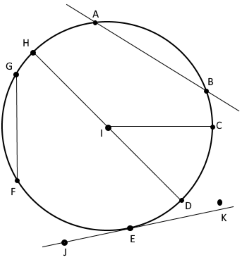
- Center: point \(I\)
- Radius: segment from center to a point on the circle (e.g., \(IC\))
- Diameter: segment through the center joining two circle points (e.g., \(HD\)); \(d = 2r\)
- Chord: segment connecting two points on the circle (e.g., \(GF\))
- Secant: line intersecting the circle at two points (e.g., \(A\), \(B\))
- Tangent: line touching the circle at exactly one point (e.g., \(JK\))
Angle bisector
Median
Altitude and the Orthocenter
Triangle bisector
Pythagorean theorem
Pythagorean triples
Circle
Square
Rectangle
Rhombus
Parallelogram
Trapezoid
Formulas for Circle Calculations
Symbols:
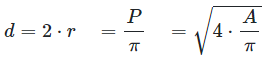
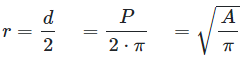
\(r\) = radius, \(d\) = diameter, \(P\) = perimeter/circumference, \(A\) = area
Calculate diameter \(d\)
Calculate radius \(r\)
Calculate area \(A\)

Calculate circumference \(P\)

Key Points
- All points on a circle have equal distance from the center
- The diameter is always twice the radius
- Circumference and area both depend on \(\pi\)
- Knowing one value (\(r\), \(d\), \(A\), or \(P\)) is enough to compute the others
\(\displaystyle d = 2r\), \(\displaystyle P = 2\pi r\), \(\displaystyle A = \pi r^2\)
|
|
|
|