Angle Bisector
Understand angle bisectors, their properties in triangles, and how to construct them
Overview
An angle bisector is a ray or line that starts from the vertex of an angle and divides the angle into two congruent (equal) parts. Each part measures exactly half of the original angle.
The angle bisector is the geometric locus of points equidistant from the two sides (rays) of an angle. It divides the angle into two equal angles.
If a ray bisects an angle of measure \(\alpha\), then each resulting angle measures \(\frac{\alpha}{2}\).
Angle bisector
Median
Altitude and the Orthocenter
Triangle bisector
Pythagorean theorem
Pythagorean triples
Circle
Square
Rectangle
Rhombus
Parallelogram
Trapezoid
Angle Bisectors in Triangles
In a triangle, angle bisectors play an important role. Each vertex has an angle bisector, and these three bisectors have special properties.
Properties of Triangle Angle Bisectors
- Every triangle has three angle bisectors, one from each vertex
- All three bisectors intersect at a single point called the incenter
- The incenter is always inside the triangle
- The incenter is equidistant from all three sides of the triangle
- The incenter is the center of the inscribed circle (incircle) of the triangle
The Incircle Center (Incenter)
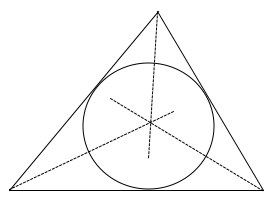
- Intersection point of all three angle bisectors
- Equidistant from all three sides of the triangle
- Center of the inscribed circle (incircle)
- The distance from the incenter to each side equals the inradius
Constructing an Angle Bisector
An angle bisector can be constructed using basic geometric tools: a ruler (straightedge) and a compass. This classical construction method is precise and requires no measurements.
Step-by-Step Construction
- Draw a circle centered at the vertex: Place the compass at the vertex of the angle and draw an arc that intersects both rays of the angle. Mark these intersection points.
- Draw two more arcs from the intersection points: Without changing the compass width, place the compass at each intersection point and draw an arc in the interior of the angle.
- Mark the intersection of the two arcs: The two arcs will intersect at a point inside the angle. Mark this intersection point.
- Draw the angle bisector: Use the ruler to draw a straight line from the vertex through the intersection point of the two arcs. This is the angle bisector.
Visual Construction Example
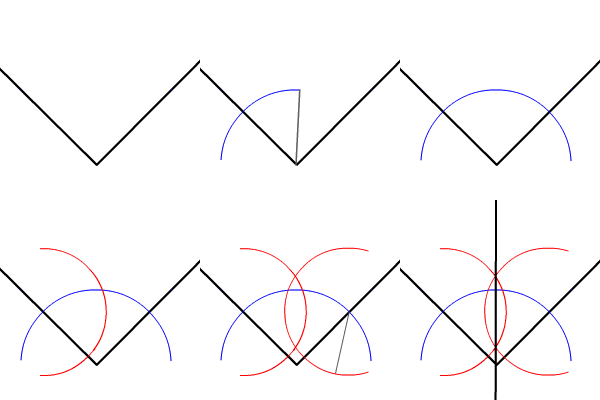
This construction is based on the principle that the angle bisector is the locus of points equidistant from the two sides of the angle. The equal arc lengths ensure we find the correct bisecting direction.
Key Points
- Angle bisector divides an angle into two equal parts
- Every triangle has three angle bisectors
- All three bisectors meet at the incenter
- The incenter is always inside the triangle
- The incenter is the center of the inscribed circle (incircle)
- The incenter is equidistant from all three sides
- Angle bisectors can be constructed with compass and ruler
- Construction uses the property of equidistant points
Online Calculator
Use the interactive calculator to compute angle bisector properties and measurements in triangles:
Angle Bisector Calculator →
|
|
|
|