Parallelogram
Properties and formulas for geometric calculations
Overview
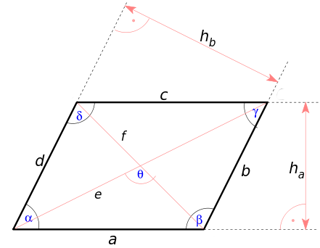
A parallelogram is a convex quadrilateral in which opposite sides are parallel. It is one of the fundamental shapes in plane geometry.
- Opposite sides are parallel and equal in length
- Opposite angles are equal
- Adjacent angles sum to 180°
- Diagonals bisect each other
Angle bisector
Median
Altitude and the Orthocenter
Triangle bisector
Pythagorean theorem
Pythagorean triples
Circle
Square
Rectangle
Rhombus
Parallelogram
Trapezoid
Formulas
Area
\(\displaystyle A=a\cdot h_a=b\cdot h_b\)
\(\displaystyle A=a\cdot b\cdot\sin(\alpha)=a\cdot b\cdot\sin(\beta)\)
Perimeter
\(\displaystyle P=2a+2b=2(a+b)\)
\(\displaystyle P=2\cdot\frac{h_a}{\sin(\alpha)}+2b\)
Heights
\(\displaystyle h_a=\sin(\alpha)\cdot a=\sin(\beta)\cdot a\)
\(\displaystyle h_a=\frac{A}{b}\)
\(\displaystyle h_b=\sin(\alpha)\cdot b=\sin(\beta)\cdot b\)
\(\displaystyle h_b=\frac{A}{a}\)
Diagonals
\(\displaystyle e=\sqrt{a^2+b^2-2ab\cos(\beta)}\) \(e =\sqrt{a^2+b^2+2ab\cos(\alpha)}\)
\(\displaystyle f=\sqrt{a^2+b^2-2ab\cos(\alpha)}\) \(f=\sqrt{a^2+b^2+2ab\cos(\beta)}\)
Interior angles
\(\displaystyle \alpha=\gamma,\ \beta=\delta,\ \alpha+\beta=180^\circ\)
\(\displaystyle \alpha=\arcsin\left(\frac{A}{a\cdot b}\right)\)
Parallelogram equation
\(\displaystyle e^2+f^2=2(a^2+b^2)\)
|
|
|
|