Cones Calculator Index
Comprehensive collection of calculators for cones and conical shapes in 3D geometry
Basic Cone Forms
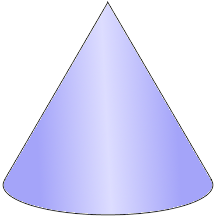
Cone (V = ⅓πr²h)
Circular cone - rotation solid from triangle around an axis
Elliptic Cone a ≠ b
Cone with elliptical base - two different semi-axes
Truncated Cones (Frustums)
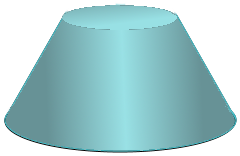
Truncated Cone Frustum
Cut cone between two parallel circles
Truncated Elliptic Cone
Cut elliptic cone between two ellipses
Double Cones (Bicones)
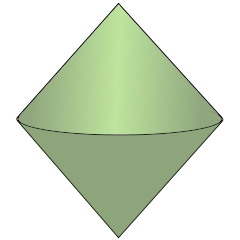
Bicone Double
Two cones with common base - mirror symmetric
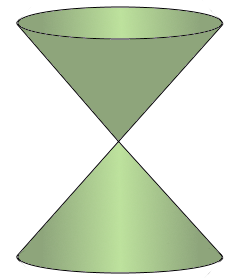
Double Cone
Variant of double cone with specific geometry
Special Cone Forms
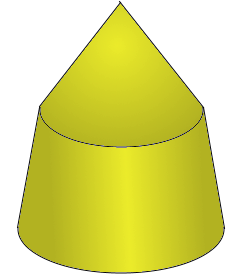
Pointed Pillar
Cylinder with conical top - combination of two basic forms
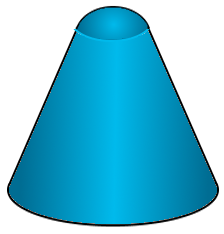
Rounded Cone Smooth
Cone with rounded tip - smooth transitions
About Cones and Conical Solids
Cones are fundamental rotation solids with diverse applications in mathematics, engineering, and nature:
- Engineering - Funnels, nozzles, valves
- Architecture - Roofs, towers, domes
- Nature - Volcanoes, cones, shells
- Mathematics - Conic sections, geometry
- Industry - Conveyors, containers
- Traffic - Pylons, warning signals
Fundamental Cone Formulas
Circular Cone
Volume: V = ⅓πr²h
Surface: M = πrs
Surface: M = πrs
Truncated Cone
V = ⅓πh(R² + Rr + r²)
Frustum formula
Frustum formula
Elliptic Cone
Volume: V = ⅓πabh
Elliptical base
Elliptical base
Slant Height
s = √(r² + h²)
Pythagorean in cone
Pythagorean in cone
Conic Sections: Plane cuts through a cone create the classical
curves: circle, ellipse, parabola, and hyperbola - foundations of analytical geometry.
Practical Applications
Engineering & Industry
- Funnels and nozzles: Optimal material flow
- Valves: Precise flow control
- Cyclones: Particle separation by rotation
Architecture & Construction
- Towers: Gothic spires, church towers
- Roofs: Conical roofing
- Foundations: Truncated cone foundations
Traffic & Safety
- Traffic cones: Visibility and stability
- Warning signals: Aerodynamic shape
- Road marking: Temporary barriers
Science & Nature
- Volcanology: Conical volcano structures
- Optics: Light cones and ray geometry
- Acoustics: Sound propagation in cones
Quick Reference
⅓πr²h
Cone Volume
πrs
Surface Area
√(r² + h²)
Slant Height
⅓πabh
Elliptic
⅓πh(R² + Rr + r²)
Truncated Cone
Historical Context
Apollonius of Perga (ca. 200 BC): Systematic study of conic sections in his work "Conics".
Archimedes (287-212 BC): Calculated cone volume using the method of exhaustion.
Modern Application: Cone shapes in aerospace, fluid dynamics, and architecture.
Properties
🔺
Rotation solid: Rotation of line around axis
📐
Conic sections: Circle, ellipse, parabola, hyperbola
⚡
Flow: Optimal shape for fluids
🏗️
Statics: Good pressure distribution in structures
🎯
Focusing: Concentration of rays
|
|