Converting Polar to Normal Form
Transform complex numbers from polar to rectangular (normal) form
Introduction to Polar-to-Normal Conversion
In the polar form representation of complex numbers, we describe them using a magnitude (distance from origin) and an angle (direction). To perform arithmetic operations or work with the real and imaginary parts directly, we often need to convert this to the normal form (also called rectangular form).
This conversion uses trigonometric functions and is essential for working with complex numbers in practical applications.
The conversion from polar to normal form extracts the real and imaginary components from the magnitude and angle using basic trigonometry.
Addition and subtraction
Multiplication
Conjugate and division
Quadratic equations
Geometric representation
Geometric addition
Absolute value
Polarform
Convert polar form to normal form
Convert normal form to polar form
Multiplication in polar form
Geometric Foundation
When we represent a complex number in the complex plane, the magnitude \(r\) and argument \(\varphi\) define a vector from the origin. This vector forms a right triangle with the real and imaginary axes.
- Hypotenuse: The vector with length \(r\)
- Horizontal leg (adjacent): The real part \(a\)
- Vertical leg (opposite): The imaginary part \(b\)
- Angle: The argument \(\varphi\) from the positive real axis
Right Triangle in the Complex Plane:
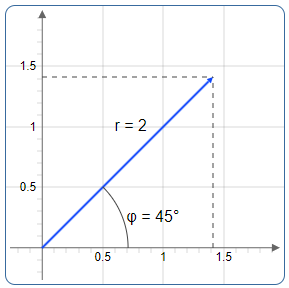
The real part is the adjacent side, imaginary part is the opposite side
Conversion Formula
Using trigonometric ratios from the right triangle, we can extract the real and imaginary parts from the magnitude and angle.
Component Extraction
Given a complex number in polar form with magnitude \(r\) and argument \(\varphi\):
\(\displaystyle a = r \cos(\varphi)\)
\(\displaystyle b = r \sin(\varphi)\)
Complete Conversion
The complex number in normal form is:
\(\displaystyle z = r(\cos\varphi + i\sin\varphi) = r\cos\varphi + ir\sin\varphi = a + bi\)
In the right triangle formed by the complex number:
- \(\cos\varphi = \frac{\text{adjacent}}{\text{hypotenuse}} = \frac{a}{r}\) → \(a = r\cos\varphi\)
- \(\sin\varphi = \frac{\text{opposite}}{\text{hypotenuse}} = \frac{b}{r}\) → \(b = r\sin\varphi\)
Step-by-Step Conversion Process
1Identify magnitude and argument
Determine \(r\) (magnitude) and \(\varphi\) (argument) from the polar form2Calculate the real part
Use \(\displaystyle a = r \cos(\varphi)\)3Calculate the imaginary part
Use \(\displaystyle b = r \sin(\varphi)\)4Write the normal form
Express as \(z = a + bi\)Conversion Examples
Example 1: 45° Angle (Simple Case)
Convert \(z = 2(\cos 45° + i\sin 45°)\) to normal form
Given: \(r = 2\), \(\varphi = 45°\)
Step 1-2: Calculate real part
Step 3: Calculate imaginary part
Step 4: Normal form
Example 2: 60° Angle
Convert \(z = 4(\cos 60° + i\sin 60°)\) to normal form
Given: \(r = 4\), \(\varphi = 60°\)
Real part:
Imaginary part:
Normal form:
Example 3: Arbitrary Angle
Convert \(z = 5(\cos 30° + i\sin 30°)\) to normal form
Given: \(r = 5\), \(\varphi = 30°\)
Real part:
Imaginary part:
Normal form:
Example 4: Standard Angles
Common conversions
- \(1(\cos 0° + i\sin 0°) = 1\)
- \(1(\cos 90° + i\sin 90°) = i\)
- \(1(\cos 180° + i\sin 180°) = -1\)
- \(1(\cos 270° + i\sin 270°) = -i\)
Special Cases and Tips
Standard Trigonometric Values
| Angle | Degrees | \(\cos(\varphi)\) | \(\sin(\varphi)\) |
|---|---|---|---|
| \(0\) | \(0°\) | \(1\) | \(0\) |
| \(\frac{\pi}{6}\) | \(30°\) | \(\frac{\sqrt{3}}{2}\) | \(\frac{1}{2}\) |
| \(\frac{\pi}{4}\) | \(45°\) | \(\frac{\sqrt{2}}{2}\) | \(\frac{\sqrt{2}}{2}\) |
| \(\frac{\pi}{3}\) | \(60°\) | \(\frac{1}{2}\) | \(\frac{\sqrt{3}}{2}\) |
| \(\frac{\pi}{2}\) | \(90°\) | \(0\) | \(1\) |
Memorizing the standard angle values (0°, 30°, 45°, 60°, 90°) significantly speeds up conversion calculations. For other angles, use a scientific calculator.
Practical Considerations
Calculator Settings
Ensure your calculator is set to the correct angle mode(degrees or radians as needed)
Verification
After conversion, verify by computing:\(\displaystyle r = \sqrt{a^2 + b^2}\)
Angle Range
Be aware that angles can be expressed in multiple equivalent forms(e.g., 270° = -90°)
Complete Circle
Angles repeat every 360° or 2π radiansUse the principal value when specified
Key Points to Remember
- The real part is calculated using cosine: \(a = r\cos(\varphi)\)
- The imaginary part is calculated using sine: \(b = r\sin(\varphi)\)
- The conversion formula is: \(z = r(\cos\varphi + i\sin\varphi) = a + bi\)
- Standard angles (0°, 30°, 45°, 60°, 90°) produce exact values
- For other angles, a calculator is needed
- Always verify the result by checking \(r = \sqrt{a^2 + b^2}\)
- Angles can be expressed in radians or degrees
|
|
|
|