Polar Form of Complex Numbers
Understanding magnitude and argument in the complex plane
Introduction to Polar Representation
In the article on geometric representation, we learned that every complex number can be represented as a vector in the complex plane. This vector is uniquely determined by its real and imaginary parts (rectangular form).
However, there is another equally valid way to describe a complex number: using its magnitude (length) and argument (angle). This is called the polar form.
Any vector can be uniquely described by either:
- Rectangular Form: Using horizontal (real) and vertical (imaginary) components
- Polar Form: Using magnitude (distance from origin) and angle (direction)
Addition and subtraction
Multiplication
Conjugate and division
Quadratic equations
Geometric representation
Geometric addition
Absolute value
Polarform
Convert polar form to normal form
Convert normal form to polar form
Multiplication in polar form
Components of Polar Form
A complex number in polar form is completely described by two parameters:
The Magnitude (Modulus)
The magnitude \(r\) (or \(|z|\)) is the distance from the origin to the point representing the complex number in the complex plane.
\(\displaystyle r = |z| = \sqrt{a^2 + b^2}\)
The Argument (Angle)
The argument \(\varphi\) (or \(\theta\)) is the angle between the positive real axis and the vector representing the complex number.
The angle is measured:
- Counterclockwise: Positive angles
- Clockwise: Negative angles
Angles are typically expressed in radians (0 to 2π) or degrees (0° to 360°). The principal argument \(\text{arg}(z)\) is usually taken to be in the range \((-\pi, \pi]\).
Polar Form Definition
The polar form of a complex number is expressed in several equivalent notations:
For a complex number with magnitude \(r\) and argument \(\varphi\):
Ordered Pair
\(\displaystyle z = (r, \varphi)\)Magnitude and argument as a pair
Trigonometric Form
\(\displaystyle z = r(\cos\varphi + i\sin\varphi)\)Using trigonometric functions
Exponential Form
\(\displaystyle z = re^{i\varphi}\)Using Euler's formula
CIS Notation
\(\displaystyle z = r\,\text{cis}(\varphi)\)Compact trigonometric form
Polar Form in the Complex Plane:
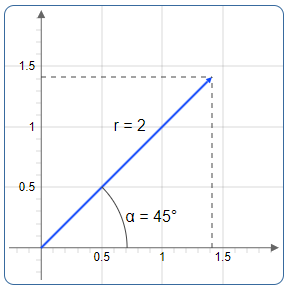
Vector with magnitude \(r\) and angle \(\varphi\) from the positive real axis
Converting Between Forms
From Rectangular to Polar Form
To convert a complex number from rectangular form \(z = a + bi\) to polar form \(z = r(\cos\varphi + i\sin\varphi)\):
1Calculate the magnitude
\(\displaystyle r = |z| = \sqrt{a^2 + b^2}\)2Calculate the argument
\(\displaystyle \varphi = \text{arctan}\left(\frac{b}{a}\right)\)The angle depends on which quadrant the complex number is in. Use the two-argument arctangent function (often called \(\text{atan2}(b, a)\)) for correct results in all quadrants.
From Polar to Rectangular Form
To convert from polar form to rectangular form:
\(\displaystyle a = r\cos\varphi \quad \text{and} \quad b = r\sin\varphi\)
Conversion Examples
Example 1: Rectangular to Polar
Convert \(z = 1 + i\) to polar form
Step 1: Calculate magnitude
Step 2: Calculate argument
Polar form: \(z = \sqrt{2}\left(\cos 45° + i\sin 45°\right)\)
Example 2: Polar to Rectangular
Convert \(z = 2(\cos 60° + i\sin 60°)\) to rectangular form
Calculate real part:
Calculate imaginary part:
Rectangular form: \(z = 1 + \sqrt{3}i\)
Example 3: Standard Angles
Common polar form examples
- \(z = 1 = 1(\cos 0° + i\sin 0°)\)
- \(z = i = 1(\cos 90° + i\sin 90°)\)
- \(z = -1 = 1(\cos 180° + i\sin 180°)\)
- \(z = -i = 1(\cos 270° + i\sin 270°)\)
Advantages of Polar Form
The polar form is particularly useful for certain operations:
Multiplication
Magnitudes multiplyArguments add
Division
Magnitudes divideArguments subtract
Powers
De Moivre's TheoremRaise magnitude to power, multiply argument
Roots
Easy to extract rootsEspecially useful for finding all roots
Polar Form Summary
| Rectangular Form | Magnitude | Argument | Polar Form (CIS) |
|---|---|---|---|
| \(1 + i\) | \(\sqrt{2}\) | \(45°\) or \(\frac{\pi}{4}\) | \(\sqrt{2}\,\text{cis}(45°)\) |
| \(1 + \sqrt{3}i\) | \(2\) | \(60°\) or \(\frac{\pi}{3}\) | \(2\,\text{cis}(60°)\) |
| \(-1 + i\) | \(\sqrt{2}\) | \(135°\) or \(\frac{3\pi}{4}\) | \(\sqrt{2}\,\text{cis}(135°)\) |
| \(3 + 4i\) | \(5\) | \(\arctan(\frac{4}{3}) \approx 53.13°\) | \(5\,\text{cis}(53.13°)\) |
Key Points to Remember
- Polar form describes a complex number by magnitude and argument
- Magnitude \(r = |z| = \sqrt{a^2 + b^2}\)
- Argument \(\varphi = \text{arg}(z)\) is the angle from the positive real axis
- Multiple equivalent notations: \((r, \varphi)\), \(r(\cos\varphi + i\sin\varphi)\), \(r\,\text{cis}(\varphi)\), \(re^{i\varphi}\)
- Polar form simplifies multiplication, division, and root extraction
- Always consider the correct quadrant when calculating the argument
|
|
|
|