Multiplication and Division in Polar Form
Simplifying complex arithmetic using polar coordinates
Introduction
One of the major advantages of the polar form representation is that multiplication and division become much simpler than in normal form. Instead of multiplying binomials, we only need to multiply magnitudes and add angles.
This geometric interpretation makes these operations intuitive and computationally efficient.
Polar form transforms complex multiplication into simple magnitude multiplication and angle addition—operations that are far easier to perform and understand geometrically.
Addition and subtraction
Multiplication
Conjugate and division
Quadratic equations
Geometric representation
Geometric addition
Absolute value
Polarform
Convert polar form to normal form
Convert normal form to polar form
Multiplication in polar form
Multiplication of Complex Numbers
The Multiplication Rule
When multiplying two complex numbers in polar form, we:
- Multiply the magnitudes: \(r_1 \cdot r_2\)
- Add the arguments: \(\varphi_1 + \varphi_2\)
For two complex numbers in polar form:
\(\displaystyle z_1 \cdot z_2 = r_1(\cos\varphi_1 + i\sin\varphi_1) \cdot r_2(\cos\varphi_2 + i\sin\varphi_2)\)
\(\displaystyle = r_1 r_2[\cos(\varphi_1 + \varphi_2) + i\sin(\varphi_1 + \varphi_2)]\)
\(\displaystyle |z_1 \cdot z_2| = |z_1| \cdot |z_2|\) and \(\arg(z_1 \cdot z_2) = \arg(z_1) + \arg(z_2)\)
Geometric Interpretation
Geometrically, multiplication in the complex plane corresponds to:
- Scaling the first vector by the magnitude of the second
- Rotating the first vector by the angle of the second
Geometric Multiplication in Polar Form:
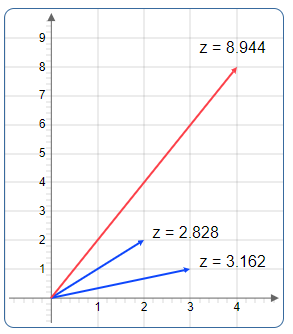
The resulting vector has magnitude \(r_1 \cdot r_2\) and angle \(\varphi_1 + \varphi_2\)
Multiplication Examples
Example 1: Simple Angles
Multiply \(z_1 = 2(\cos 30° + i\sin 30°)\) and \(z_2 = 3(\cos 45° + i\sin 45°)\)
Step 1: Identify magnitudes and arguments
- \(r_1 = 2\), \(\varphi_1 = 30°\)
- \(r_2 = 3\), \(\varphi_2 = 45°\)
Step 2: Multiply magnitudes
Step 3: Add arguments
Result: \(z_1 \cdot z_2 = 6(\cos 75° + i\sin 75°)\)
Example 2: Right Angles
Multiply \(z_1 = 2(\cos 0° + i\sin 0°) = 2\) and \(z_2 = 3(\cos 90° + i\sin 90°) = 3i\)
Polar multiplication:
\(\displaystyle \varphi = 0° + 90° = 90°\)
Result: \(z_1 \cdot z_2 = 6(\cos 90° + i\sin 90°) = 6i\)
Verification (normal form): \(2 \cdot 3i = 6i\) ✓
Division of Complex Numbers
The Division Rule
Division in polar form is equally elegant. When dividing, we:
- Divide the magnitudes: \(\frac{r_1}{r_2}\)
- Subtract the arguments: \(\varphi_1 - \varphi_2\)
For two complex numbers in polar form (with \(z_2 \neq 0\)):
\(\displaystyle \frac{z_1}{z_2} = \frac{r_1(\cos\varphi_1 + i\sin\varphi_1)}{r_2(\cos\varphi_2 + i\sin\varphi_2)}\)
\(\displaystyle = \frac{r_1}{r_2}[\cos(\varphi_1 - \varphi_2) + i\sin(\varphi_1 - \varphi_2)]\)
\(\displaystyle \left|\frac{z_1}{z_2}\right| = \frac{|z_1|}{|z_2|}\) and \(\arg\left(\frac{z_1}{z_2}\right) = \arg(z_1) - \arg(z_2)\)
Division Examples
Example 1: Simple Angles
Divide \(z_1 = 8(\cos 120° + i\sin 120°)\) by \(z_2 = 2(\cos 30° + i\sin 30°)\)
Step 1: Identify magnitudes and arguments
- \(r_1 = 8\), \(\varphi_1 = 120°\)
- \(r_2 = 2\), \(\varphi_2 = 30°\)
Step 2: Divide magnitudes
Step 3: Subtract arguments
Result: \(\displaystyle \frac{z_1}{z_2} = 4(\cos 90° + i\sin 90°) = 4i\)
Example 2: Equal Magnitudes
Divide \(z_1 = 5(\cos 60° + i\sin 60°)\) by \(z_2 = 5(\cos 15° + i\sin 15°)\)
Polar division:
\(\displaystyle \varphi = 60° - 15° = 45°\)
Result: \(\displaystyle \frac{z_1}{z_2} = 1(\cos 45° + i\sin 45°) = \frac{\sqrt{2}}{2} + i\frac{\sqrt{2}}{2}\)
Multiplication and Division Summary
| Operation | Normal Form | Polar Form | Computational Complexity |
|---|---|---|---|
| Multiplication | Complex (FOIL) | Multiply \(r\), add \(\varphi\) | Much simpler |
| Division | Complex (rationalize) | Divide \(r\), subtract \(\varphi\) | Much simpler |
| Powers | Very complex | De Moivre: \(r^n\), multiply \(\varphi\) by \(n\) | Extremely simple |
Advantages of Polar Form Operations
Speed
Simple arithmetic operationsNo binomial expansion needed
Geometric Insight
Clear geometric meaningScaling and rotation operations
Error Reduction
Fewer algebraic stepsLess chance for mistakes
Computer Efficiency
Faster computationBetter for numerical algorithms
Key Points to Remember
- Multiplication: Multiply magnitudes, add arguments
- Division: Divide magnitudes, subtract arguments
- Formula for multiplication: \(z_1 \cdot z_2 = r_1 r_2[\cos(\varphi_1 + \varphi_2) + i\sin(\varphi_1 + \varphi_2)]\)
- Formula for division: \(\displaystyle \frac{z_1}{z_2} = \frac{r_1}{r_2}[\cos(\varphi_1 - \varphi_2) + i\sin(\varphi_1 - \varphi_2)]\)
- Polar form is much simpler for multiplication and division than normal form
- This is one of the main reasons polar form is used in engineering and physics
- Angles may need adjustment if result exceeds 360° or is negative
|
|
|
|