Calculate Bessel-I Function
Online calculator for the modified Bessel function Iᵥ(z) of the first kind - Exponential behavior for heat conduction and waveguides
Bessel-I Function Calculator
Modified Bessel Function
The Iᵥ(z) or modified Bessel function shows exponential behavior instead of oscillation and is important for cylindrical symmetry.
Bessel-I Function Curve
Mouse pointer on the graph shows the values.
The modified Bessel function shows exponential growth.
Why exponential instead of oscillatory behavior?
The modified Bessel function differs fundamentally from the ordinary Bessel function:
- Exponential growth: Iᵥ(z) grows exponentially for large z
- No oscillation: No periodic up and down behavior
- Physical relevance: Describes diffusion and heat conduction
- Cylindrical symmetry: Important for cylindrical coordinates
- Monotonicity: Strictly monotonically increasing for z > 0
- Asymptotics: Iᵥ(z) ~ e^z/√(2πz) for large z
Applications in cylindrical systems
The modified Bessel function is fundamental for problems with cylindrical symmetry:
Heat Conduction
- Temperature distribution in cylinders
- Heat conduction in pipelines
- Cooling/heating of cylindrical objects
Electromagnetics
- Waveguides (coaxial cables)
- Electromagnetic fields
- Antenna theory
Formulas for the Bessel-I Function
Definition via J-Function
Relationship to ordinary Bessel function
Recurrence Formula
Relationship between different orders
Series Expansion
Power series expansion
Integral Representation
For integer order n
Asymptotic Form
For large z
Special Values
Important Values
Symmetry Properties
For integer n
Behavior at z = 0
Limiting behavior at origin
Application Areas
Heat conduction, electromagnetic waveguides, diffusion processes, statistical mechanics.
Wronskian Determinant
With K-function (second kind)
Comparison of Bessel Functions
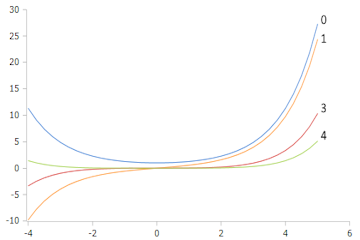
Bessel-I Functions (Order 0,1,3,4)
All show exponential growth for large z values. Higher orders start flatter but also grow exponentially.
Characteristic Properties
- I₀(z) starts at 1 and grows monotonically
- Iₙ(z) with n > 0 starts at 0
- All functions are strictly convex
- Asymptotically: ~ e^z/√(2πz)
Detailed Description of the Bessel-I Function
Mathematical Definition
The modified Bessel function of the first kind Iᵥ(z) is a fundamental solution of the modified Bessel differential equation. Unlike the ordinary Bessel function, it shows exponential growth instead of oscillatory behavior.
Using the Calculator
Enter the order ν (integer) and the argument z (positive real number). For negative z, the result may become complex.
Historical Background
The modified Bessel functions were developed by Friedrich Bessel (1784-1846) and later systematized by Lord Kelvin and others for physical applications. The name "modified" refers to the transformation iz → z.
Properties and Applications
Physical Applications
- Heat conduction in cylindrical objects
- Electromagnetic waveguides
- Diffusion processes with cylindrical symmetry
- Membrane vibrations
Mathematical Properties
- Exponential growth for large z
- Strict monotonicity for z > 0
- Symmetry: I₋ₙ(z) = Iₙ(z) for integer n
- Convexity for all real z > 0
Numerical Aspects
- Stability: Numerically stable for z ≥ 0
- Scaling: Exponential growth requires caution
- Recursion: Efficient computation via recurrence formulas
- Asymptotics: Asymptotic expansions for large z
Interesting Facts
- Function I₀(z) describes the probability density of the von Mises distribution
- For very small z: Iᵥ(z) ≈ (z/2)^ν / Γ(ν+1)
- The functions satisfy the modified Bessel differential equation
- Important in quantum field theory and statistical mechanics
Calculation Examples
Example 1
I₀(1) ≈ 1.266
Bessel-I zeroth order at z = 1
Example 2
I₁(2) ≈ 1.591
Bessel-I first order at z = 2
Example 3
I₂(3) ≈ 2.245
Bessel-I second order at z = 3
Bessel Functions Classification
Bessel of the First Kind (Jᵥ)
Solutions of the standard Bessel equation:
Oscillatory behavior, finite at z = 0 for ν ≥ 0.
Bessel of the Second Kind (Yᵥ)
Also called Neumann functions:
Singular at z = 0, oscillating for large z.
Modified Bessel (Iᵥ, Kᵥ)
Exponential behavior:
Iᵥ: exponentially growing, Kᵥ: exponentially decaying.
Differential Equation and Solution Theory
Modified Bessel Equation
The modified Bessel equation with parameter ν.
General Solution
Linear combination of the two linearly independent solutions.
|
|
|
|