Calculate Bessel-Ie Function
Online calculator for the exponentially scaled modified Bessel function Ieᵥ(z) - Numerically stable for large arguments
Bessel-Ie Function Calculator
Exponentially Scaled Bessel Function
The Ieᵥ(z) or exponentially scaled modified Bessel function provides numerical stability for large arguments.
Bessel-Ie Function Curve
Mouse pointer on the graph shows the values.
The exponentially scaled form is numerically more stable for large z.
Why exponential scaling?
The exponentially scaled modified Bessel function solves numerical problems:
- Numerical stability: Prevents overflow for large z
- Exponential factor: Ieᵥ(z) = e^(-z) Iᵥ(z)
- Precision: Maintains accuracy for all z ranges
- Implementation: Standard in numerical libraries
- Range extension: Computation for very large arguments
- Robustness: Avoids machine precision problems
Numerical advantages over standard Bessel-I
The exponentially scaled version offers crucial numerical advantages:
Problem with standard Iᵥ(z)
- Exponential growth ~ e^z
- Overflow at z > ~700
- Loss of precision
Solution through Ieᵥ(z)
- Scaled range without overflow
- Stable computation for all z
- Preserved relative accuracy
Formulas for the Bessel-Ie Function
Definition
Exponentially scaled modified Bessel function
Relationship to Iᵥ
Inversion of scaling
Series Expansion
Scaled power series
Asymptotic Form
For large z (without exponential growth)
Recurrence Formula
Same recurrence as unscaled version
Integral Representation
For integer order n
Special Values
Important Values
Symmetry Properties
For integer n
Behavior at z = 0
Same behavior as Iᵥ(0)
Application Areas
Numerical computations, large parameters, scientific computing, libraries.
Bessel-Ie vs. Bessel-I Comparison
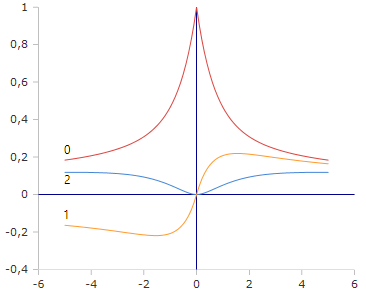
Bessel-Ie Functions (Order 0,1,2)
The exponentially scaled functions show controlled growth without numerical overflows even for large z values.
Characteristic Properties
- Ie₀(z) starts at 1, then decreases
- Ieₙ(z) with n > 0 starts at 0
- Asymptotically: ~ 1/√(2πz)
- No exponential overflows
Detailed Description of the Bessel-Ie Function
Mathematical Definition
The exponentially scaled modified Bessel function Ieᵥ(z) is a numerically stabilized version of the modified Bessel function Iᵥ(z). It was developed to solve the numerical problems of exponential growth.
Using the Calculator
Enter the order ν (integer) and the argument z (positive real number). The Ie version is particularly suitable for large z values.
Numerical Background
The development of exponentially scaled Bessel functions was a response to the challenges of scientific computing. While Iᵥ(z) grows exponentially for large z and causes overflows, Ieᵥ(z) remains within controlled limits.
Properties and Applications
Numerical Applications
- Scientific computing with large parameters
- Numerical libraries (MATLAB, SciPy, GSL)
- Simulation of physical systems
- Statistical calculations
Mathematical Properties
- Bounded growth for large z
- Asymptotically: ~ 1/√(2πz)
- Symmetry: Ie₋ₙ(z) = Ieₙ(z) for integer n
- Monotonicity properties similar to standard version
Implementation Aspects
- Libraries: Standard in modern math libraries
- Precision: Maintained accuracy for all z ranges
- Performance: Optimized algorithms available
- Portability: Platform-independent implementations
Interesting Facts
- The Ie functions are standard in IEEE floating-point implementations
- For small z: Ieᵥ(z) ≈ e^(-z) (z/2)^ν / Γ(ν+1)
- Algorithms often use continued fractions for higher efficiency
- Important in Monte Carlo simulations with large parameters
Calculation Examples and Comparisons
Small Argument
z = 1:
I₀(1) ≈ 1.266
Ie₀(1) ≈ 0.466
Medium Argument
z = 10:
I₀(10) ≈ 2815.7
Ie₀(10) ≈ 0.1278
Large Argument
z = 100:
I₀(100) → Overflow
Ie₀(100) ≈ 0.0398
Computational Comparison
Standard Iᵥ(z) Problems
Exponential Growth:
I₀(50) ≈ 1.1 × 10²¹
I₀(100) ≈ 1.1 × 10⁴²
I₀(700) → Overflow
Problem: Numerical overflows significantly limit the usable range.
Ieᵥ(z) Solution
Controlled Behavior:
Ie₀(50) ≈ 0.0564
Ie₀(100) ≈ 0.0398
Ie₀(700) ≈ 0.0151
Advantage: Stable computation for arbitrarily large arguments.
Algorithmic Implementation
Numerical Methods
- Continued Fractions: For large z and small ν
- Miller's Algorithm: For medium z ranges
- Series Expansion: For small z
- Uniform Asymptotic: For large ν
Software Implementations
- GSL: GNU Scientific Library
- Boost: C++ Boost Math Library
- SciPy: Python scientific computing
- MATLAB: Built-in besseli function with scaling
|
|
|
|