Modified Bessel-K Function for Complex Numbers
Calculation of the modified Bessel function \(K_\nu(z)\) of the second kind with exponentially decaying behavior
Bessel-K Function Calculator
Modified Bessel Function \(K_\nu(z)\) of the Second Kind
The modified Bessel function of the second kind \(K_\nu(z)\) exhibits exponentially decaying behavior and is singular at the origin. It is a solution of the modified Bessel differential equation.
Bessel-K Properties
Behavior
Decaying
Exponentially → 0
For large |z|Kind
Second Kind
Type: \(K_\nu\)
Singular at z=0Order
ν ∈ ℝ
Any real number
Integer or rationalArgument
z ∈ ℂ
Complex: a+bi
Real and imaginary partImportant Properties
- Solution of the modified Bessel differential equation
- Exponentially decaying behavior: \(K_\nu(z) \sim \sqrt{\frac{\pi}{2z}} e^{-z}\)
- Singularity at the origin: \(K_\nu(0) = \infty\) (except special cases)
- Symmetry relation: \(K_{-\nu}(z) = K_\nu(z)\)
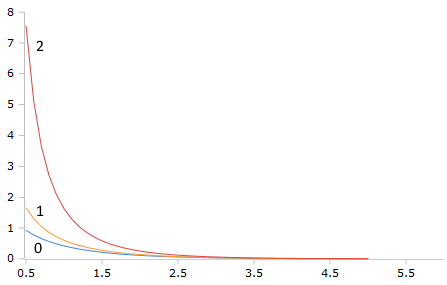
Plot of the Bessel-K function with orders 0, 1 and 2
Definition of the Modified Bessel-K Function of the Second Kind
The modified Bessel function of the second kind \(K_\nu(z)\) is defined by:
Standard Definition
Definition through the modified Bessel functions of the first kind \(I_\nu(z)\) and \(I_{-\nu}(z)\)
Modified Bessel ODE
Differential equation with solution \(w = K_\nu(z)\)
Integral Representation
Valid for \(\text{Re}(z) > 0\)
Important Properties of the Bessel-K Function
Asymptotic Behavior
Exponentially decaying for large |z|
Behavior at the Origin
Singular at the origin for all ν
Symmetry Relations
Symmetry with respect to order
Recurrence Relations
Relations between different orders
Applications of the Bessel-K Function
Heat Conduction
Potential Theory
Cylindrical Charges
Shielding
Mass Potentials
Cylindrical Distributions
Stochastics & Finance
Option Pricing Models
Brownian Motion
Variance Gamma Processes
Quantum Physics
Yukawa Potential
Scattering Theory
Shielding Effects
Tunneling Effects
Modified Bessel-K Functions - Detailed Description
Exponentially Decaying Behavior
The modified Bessel function of the second kind \(K_\nu(z)\) differs fundamentally from \(I_\nu(z)\) by its exponentially decaying behavior.
• Exponential decay for large |z|
• Singularity at the origin (z=0)
• Always positive for real positive z
• Bounded for large arguments
Historical Background
The modified Bessel functions were developed from the ordinary Bessel functions through the transformation \(z \to iz\). The K-functions are especially important for problems with exponentially decaying solutions.
Physical Interpretation
\(K_0(r)\) describes the steady-state temperature field of an infinitely long line heat source in an unbounded medium. The function decays exponentially with distance r.
Numerical Aspects
The K-functions are numerically well-behaved, as they decay exponentially for large arguments and exhibit no oscillations.
• No overflow problems for large |z|
• Stable calculations possible
• Forward recurrence stable
• Singularity at origin requires caution
Calculation Methods
Various numerical methods are used depending on the argument range:
Moderate |z|: Integral representation
Large |z|: Asymptotic expansion \(\sim e^{-z}/\sqrt{z}\)
Complex z: Special algorithms required
Special Values
Some important limits:
\(\lim_{z \to 0^+} K_0(z) = +\infty\) (logarithmic singularity)
\(\lim_{z \to \infty} K_\nu(z) = 0\) (exponential decay)
Comparison: Bessel-K vs. Bessel-I
Modified Bessel-K Function (second kind)
Behavior: Exponentially decaying
ODE: \(z^2w'' + zw' - (z^2+\nu^2)w = 0\)
Asymptotics: \(\sim \sqrt{\frac{\pi}{2z}} e^{-z}\)
Origin: Singular at z=0
Modified Bessel-I Function (first kind)
Behavior: Exponentially growing
ODE: \(z^2w'' + zw' - (z^2+\nu^2)w = 0\)
Asymptotics: \(\sim \frac{e^z}{\sqrt{2\pi z}}\)
Origin: Finite at z=0
Application Guidelines
- Heat conduction: K for cooling, heat dissipation
- Diffusion: K for concentration decrease
- Yukawa potential: K-function describes shielding
- Unbounded domains: K for boundary behavior at infinity
- Steady states: K for exponential decay
- Mathematical finance: K in option pricing models
Bessel Functions - Complete Definitions and Relations
Ordinary Bessel Functions
The Bessel function of the first kind of order n is defined as:
The Bessel function of the second kind (Neumann function) is:
Applications of J-Functions
Ordinary Bessel functions for oscillating phenomena with cylindrical symmetry: vibrations, electromagnetic waves, quantum mechanics.
Modified Bessel Functions
The modified Bessel function of the first kind is defined as:
The modified Bessel function of the second kind is:
Wronskian Determinant
For the modified Bessel functions:
\(W[I_\nu(z), K_\nu(z)] = I_\nu(z)K_\nu'(z) - I_\nu'(z)K_\nu(z) = -\frac{1}{z}\)
This shows that \(I_\nu\) and \(K_\nu\) are linearly independent solutions of the modified Bessel differential equation.
|
|
|
|
More complex functions
Absolute value (abs) • Angle • Conjugate • Division • Exponent • Logarithm to base 10 • Multiplication • Natural logarithm • Polarform • Power • Root • Reciprocal • Square root •Cosh • Sinh • Tanh •
Acos • Asin • Atan • Cos • Sin • Tan •
Airy function • Derivative Airy function •
Bessel-I • Bessel-Ie • Bessel-J • Bessel-Je • Bessel-K • Bessel-Ke • Bessel-Y • Bessel-Ye •