Exponentially Scaled Bessel-Ke Function for Complex Numbers
Calculation of the exponentially scaled Bessel function \(K_e(z) = e^z K_\nu(z)\) of the second kind
Bessel-Ke Function Calculator
Exponentially Scaled Bessel Function \(K_e(z)\)
The exponentially scaled modified Bessel function \(K_e(z) = e^z K_\nu(z)\) prevents numerical underflows for large arguments by compensating the exponential decay of \(K_\nu(z)\).
Bessel-Ke Properties
Scaling
Exponential
Factor: \(e^z\)
Prevents underflowOriginal
Decaying
Type: \(K_\nu(z)\)
Exponentially → 0Order
ν ∈ ℝ
Any real number
Integer or rationalArgument
z ∈ ℂ
Complex: a+bi
Real and imaginary partImportant Properties
- Numerically stable calculation for large |z|
- Compensates exponential decay of \(K_\nu(z)\)
- Defined as: \(K_e(z) = e^z K_\nu(z)\)
- Asymptotically: \(K_e(z) \sim \sqrt{\frac{\pi}{2z}}\) for |z| → ∞
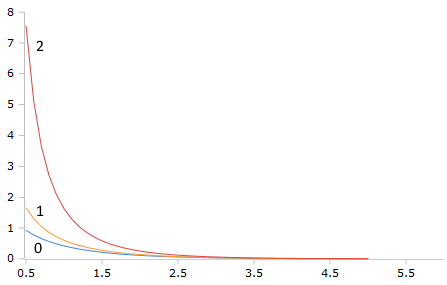
Plot of the Bessel-K function (before exponential scaling)
Definition of the Exponentially Scaled Bessel-Ke Function
The exponentially scaled modified Bessel function of the second kind \(K_e(z)\) is defined as:
Scaled Definition
Exponentially scaled version to avoid numerical underflows in decaying functions
Numerical Stability
Bounded for large |z|, prevents underflow
Relationship to Bessel-K
Back-transformation to the original function
Important Properties of the Scaled Bessel-Ke Function
Asymptotic Behavior
Bounded behavior for large |z| (without exponential factor)
Numerical Advantages
Avoids underflow despite exponential decay of \(K_\nu\)
Scaling Factor
Exponential amplification factor compensates decay
Recurrence Relations
Scaled recurrence relations apply analogously
Applications of the Scaled Bessel-Ke Function
Numerical Analysis
Heat Conduction
Large distances
Steady states
Long-term behavior
Decay processes
Quantum Physics
Yukawa potential
Screening
Far-field analysis
Financial Mathematics
Option prices
Variance-gamma
Long-term risk
Tail behavior
Exponentially Scaled Bessel-Ke Functions - Detailed Description
Numerical Stability with Decay
The exponentially scaled Bessel-Ke function \(K_e(z)\) was developed to solve the numerical problems of the modified Bessel function \(K_\nu(z)\) for large arguments, where the function decays exponentially to zero.
• \(K_\nu(z) \sim e^{-z}/\sqrt{z}\) for large |z|
• Numerical underflows for large |z|
• Loss of precision due to very small values
• Difficult calculation of ratios
Solution Approach
By the definition \(K_e(z) = e^z K_\nu(z)\), the exponentially decaying function is provided with an exponential amplification factor, so that the resulting function remains numerically manageable.
Advantages of Scaling
Without scaling: \(K_\nu(100) \approx 10^{-44}\) (underflow!)
With scaling: \(K_{e,\nu}(100) \approx 0.088\) (stable)
Mathematical Properties
The scaled function retains all important mathematical properties of the original decaying Bessel function, but is numerically more stable.
• Recurrence relations remain valid
• Symmetry relations persist
• Singularity at origin preserved
• Asymptotic behavior known
Implementation
In numerical practice, the scaled version is used for large arguments and the result is back-transformed if needed:
Caution: Back-transformation can cause underflow again!
Computer Implementation
Modern libraries use the scaled version automatically for large arguments and handle the scaling transparently in the background.
Comparison: Scaled vs. Unscaled
Unscaled Bessel-K Function
Behavior: Exponentially decaying
Problems: Underflow for large |z|
Numerics: Critical for |z| > 50
Scaled Bessel-Ke Function
Behavior: Asymptotically constant
Advantages: No underflow problems
Range: All |z| (practically unlimited)
Practical Application Guidelines
- Small |z| ≤ 10: Both versions usable
- Medium |z| ≤ 50: Scaled version recommended
- Large |z| > 50: Only use scaled version
- Heat conduction: Always scaled version in far-field
- Yukawa potential: Scaling for large distances
- Financial mathematics: Transparent scaling
Bessel Functions - Complete Definitions and Scaling
Ordinary Bessel Functions
The Bessel function of the first kind of order n is defined as:
The Bessel function of the second kind is:
Modified Bessel Functions
The modified Bessel function of the first kind is:
The modified Bessel function of the second kind is:
The exponentially scaled version is:
Application Areas
The exponentially scaled Bessel-Ke function is particularly important for far-field analyses with exponentially decaying solutions, heat conduction over large distances, Yukawa potentials, and all areas where \(K_\nu(z)\) must be calculated for large arguments.
|
|
|
|
More complex functions
Absolute value (abs) • Angle • Conjugate • Division • Exponent • Logarithm to base 10 • Multiplication • Natural logarithm • Polarform • Power • Root • Reciprocal • Square root •Cosh • Sinh • Tanh •
Acos • Asin • Atan • Cos • Sin • Tan •
Airy function • Derivative Airy function •
Bessel-I • Bessel-Ie • Bessel-J • Bessel-Je • Bessel-K • Bessel-Ke • Bessel-Y • Bessel-Ye •